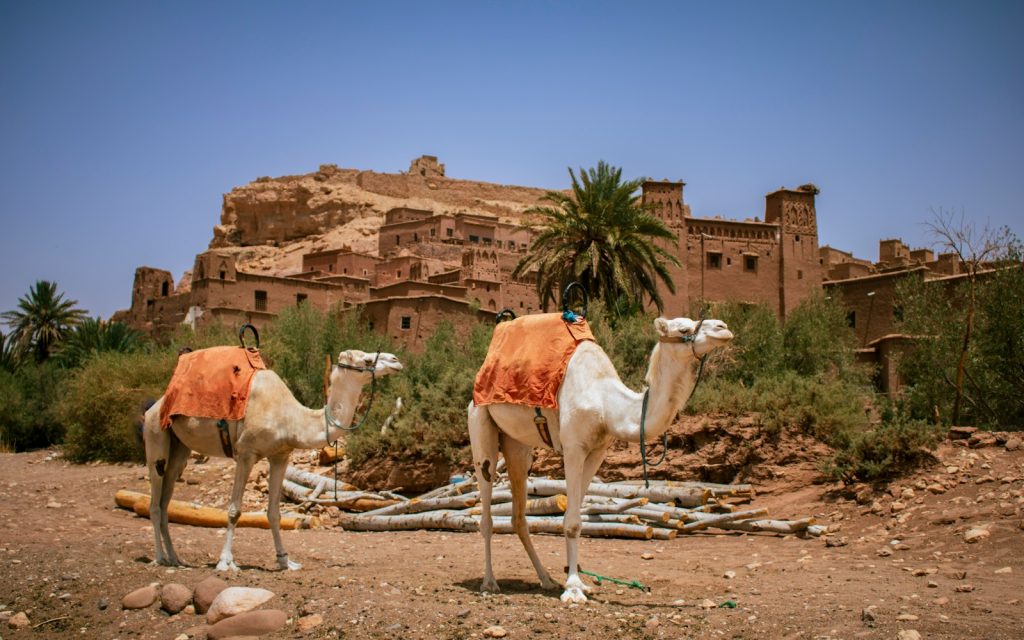
There’s a moment, somewhere on the road south from Marrakesh, when the High Atlas mountains fall away behind you and the light changes completely. The green disappears. The horizon opens up into ochre and rose-gold hills, and you realize you’ve crossed into a different Morocco entirely the Morocco of kasbahs, palm oases, and dunes that stretch to Algeria. This is Ouarzazate and the southern desert, and it rewards travelers who take their time and stay well.
Ouarzazate: The Gateway With Its Own Gravity
Ouarzazate has long been known as Morocco’s “door to the desert,” and also, more surprisingly, as its Hollywood the dry light and dramatic landscapes have drawn film productions here for decades. But it’s worth treating as more than a pit stop.
For a luxury base, Kasbah Tamsna stands out for its architectural restraint and stillness guests describe watching the sunset from the roof with a glass of Moroccan wine as one of the most memorable moments of an entire Morocco itinerary. If you prefer something closer to town with a spa and pool, Berbère Palace delivers ornate Berber-inspired interiors and gardens that feel like a private retreat, while Hôtel Riad Dar Daïf, just outside the city, offers snow-capped Atlas views, a hammam, and guides who know the surrounding mountains intimately enough to lead you off the beaten path.
Just outside Ouarzazate sits Aït Benhaddou, the UNESCO-listed fortified village of earthen kasbahs rising from the valley floor. It’s one of the most photographed sites in Morocco for good reason and best visited early morning or late afternoon, when the clay walls glow amber.
Skoura: Palm Groves and Slow Luxury
An easy detour east of Ouarzazate, the Skoura oasis is where the desert-luxury experience really opens up. This is palm-grove country, dotted with centuries-old kasbahs, many of them quietly restored into some of the finest small hotels in Morocco.
Dar Ahlam is the standout here — a discreet, all-inclusive kasbah retreat where nothing is fixed on a menu or a schedule. Meals appear as private, candlelit surprises in hidden corners of the property or out in the palmery, and the hotel even runs its own nomad-style camp experience in the Sahara for guests who want to extend the sense of theater into the dunes. Ksar El Kabbaba offers a gentler, more classic version of the same idea: manicured gardens, a spa worth booking a day ahead, and a kitchen turning out food that regularly surprises guests expecting simple tagines. And Kasbah Ait Ben Hadda, built from clay and straw in the traditional style, is a favorite one-night stop for its natural insulation, dune views right from the pool, and a four-course dinner that punches well above its price point.
The Road Through Dades and Todra
Between Skoura and the deep desert, the route climbs through the Dades Valley and its gorges — a landscape of folded red rock, riverbed palmeries, and switchback roads that locals nickname the “Valley of a Thousand Kasbahs.” It’s a natural place to break the journey with a scenic lunch stop or an overnight before pushing on toward the dunes, and many of the boutique kasbah hotels along this stretch make the most of clifftop or valley-floor views.
Merzouga and the Erg Chebbi Dunes
The final stretch east leads to Merzouga and the towering dunes of Erg Chebbi some of the tallest and most cinematic in Morocco. This is where the “luxury desert camp” experience comes into its own: private tents with real beds and en-suite bathrooms, generator-powered air conditioning or heating depending on the season, candlelit Berber dinners, and staff who orchestrate camel treks or 4×4 dune runs timed precisely to catch sunset over the sand.
Camps like the Sahara Desert Luxury Camp and Merzouga Luxury Desert Camps have built reputations on exactly this formula — comfortable, well-run tents; evening entertainment around the fire; and genuinely spectacular sunrise views for those willing to wake before dawn. A few practical notes worth knowing before you book: nights in the desert get cold even when days are scorching, so pack thermal layers regardless of season, and camel transfers to camp can run over an hour, so ask about 4×4 alternatives if a long ride isn’t appealing.
Planning It Well
The southern desert rewards a slower pace. Rather than a single overnight dash to Merzouga and back, consider:
- Marrakesh → Ouarzazate (via Aït Benhaddou), one or two nights
- Skoura, one to two nights at a kasbah retreat
- Dades Valley, an overnight or scenic stopover
- Merzouga / Erg Chebbi, one or two nights in a luxury desert camp
- Return via the same route, or loop back through the Todra Gorge
Done this way, the trip becomes less about covering distance and more about watching the landscape and the light transform completely, kasbah by kasbah, all the way to the dunes.